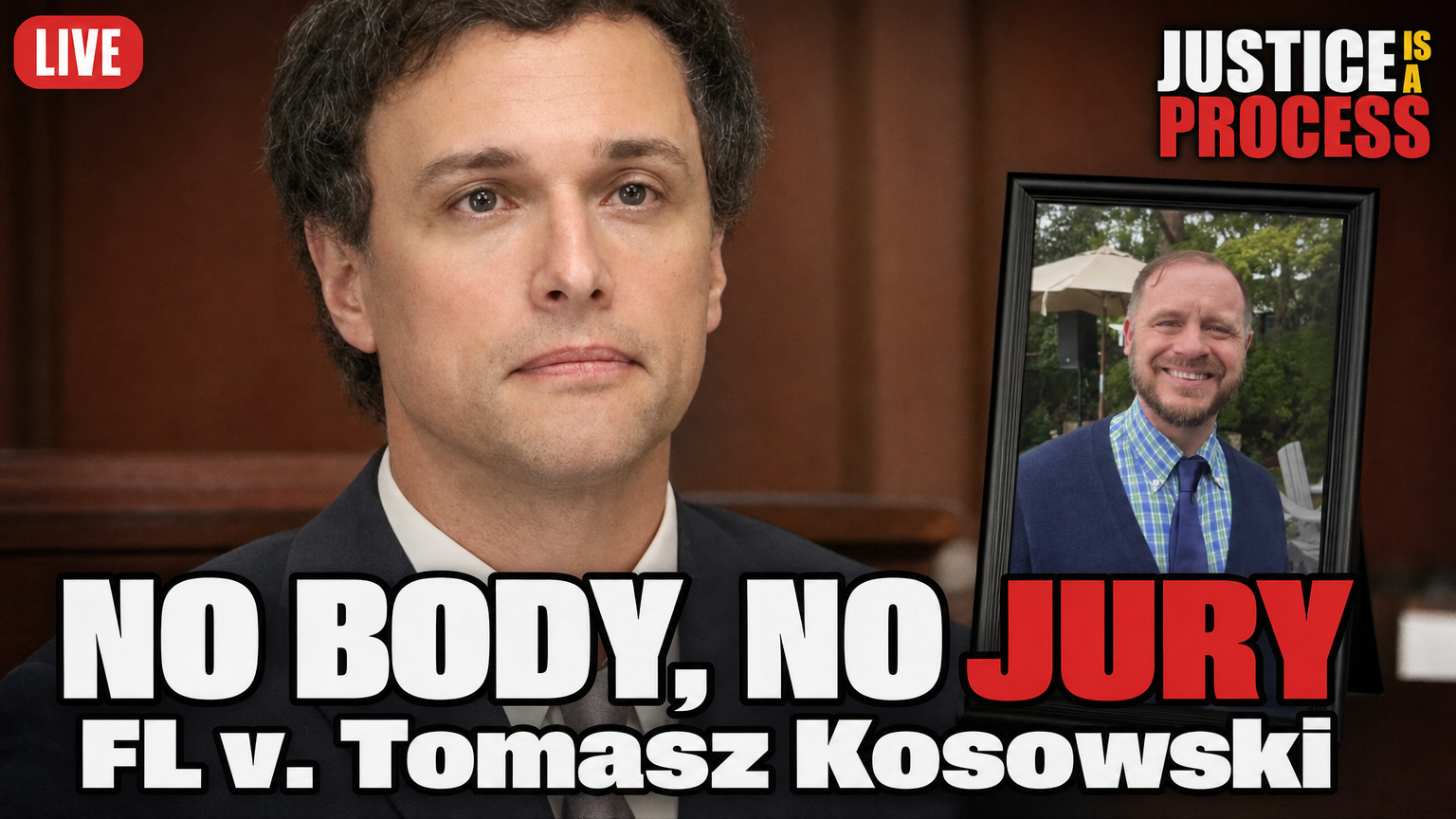
A plastic surgeon, a missing lawyer, and a defendant who stopped fighting his own case
September 2026 | Justice Is A Process
On the afternoon of March 21, 2023, attorney Steven Cozzi got up from his desk at a small law office in Largo, Florida, and walked toward the bathroom.
He never walked back.
His keys stayed on the desk. So did his wallet, his cellphone, his laptop, his tablet, and a work file still open on the screen. Cozzi was 41 years old, and by the next day it was clear he had not simply stepped out for air. More than three years later, his body has still never been found.
The man accused of killing him is Dr. Tomasz Kosowski, a Pinellas County plastic surgeon who sued one of Cozzi's clients for money, stopped defending the case, and was weeks from losing it when Cozzi disappeared. The State's theory is that Kosowski's professional grievance over that lawsuit curdled into a killing, allegedly carried out in a law office bathroom, cleaned up in a home garage, and disposed of on a remote stretch of highway west of Miami.
Now, more than three years after Cozzi vanished, Kosowski is 47 years old and about to go on trial for his life. He has burned through four separate defense teams. Weeks before jury selection was set to begin, he decided he would rather represent himself. Then he went further: he waived his right to a jury not once, but twice, once for the question of whether he is guilty, and again for the question of whether the State should be allowed to execute him if he is. When a judge pointed out that this left the entirety of his fate in the hands of one person, Kosowski's answer was five words: "It makes sense to me."
Prosecutors intend to seek the death penalty. Kosowski has pleaded not guilty. On Monday, September 14, 2026, inside a Pinellas County courtroom, a trial is set to open that the State must win without a body, without a murder weapon, and without a confession, against a defendant who, by his own conduct in the run-up to trial, does not appear to be trying especially hard to stop them.
We are not here to convict or acquit. We are here to watch whether a system built to require proof beyond a reasonable doubt can still do its job when the person it is judging seems to have stopped asking it to.
This is Justice Is A Process. Let's begin.
According to prosecutors, Kosowski and Cozzi took part in a conference call on March 21, 2023, about an ongoing and increasingly hostile legal fight over medical billing. Cozzi represented a Dunedin, Florida based medical practice that Kosowski had sued, alleging the practice shorted him thousands of dollars and damaged his professional reputation as a doctor. Court filings quote Kosowski's own lawsuit language: that "through no fault of his own, his career was put directly in jeopardy."
The State alleges that within a short time of that call ending, Kosowski killed Cozzi inside the bathroom of Cozzi's law office, Blanchard Law, in Largo. It was reportedly not the first heated encounter between the two men at that office; prosecutors have pointed to an earlier bathroom confrontation in which Kosowski allegedly called Cozzi a "scumbag."
Cozzi's disappearance had none of the ambiguity that sometimes surrounds a missing-persons case. He left behind the items a person takes when they leave a building on their own: his keys, his wallet, his phone, his laptop, his tablet, an open file on his desk. None of it moved. He did not go home. He has not been heard from since.
Investigators say the physical evidence trail runs from the bathroom at Blanchard Law to Kosowski's own property. According to prosecutors and court filings, Cozzi's blood and DNA were found in that bathroom, and a mixture of Cozzi's blood and Kosowski's DNA was later found on the floor of Kosowski's garage and inside a Toyota Tundra pickup truck investigators tie to Kosowski. That truck, according to reporting on the case, had been bought with cash weeks before Cozzi disappeared, was never formally registered in Kosowski's name, and was equipped with a device capable of flipping between license plates, one of which was registered to a person who was already deceased.
Cellphone records, prosecutors allege, placed Kosowski at the law office around the time of Cozzi's disappearance. Surveillance video described in reporting on the case allegedly tracks a truck matching Kosowski's to a remote area along U.S. Highway 41, the Tamiami Trail, west of Miami. Investigators say a garbage truck captured on video was seen picking up a large bag from a Dumpster in that area in a manner one driver described as inconsistent with ordinary trash, and that the same driver later described an unusually foul smell. A cadaver dog reportedly indicated that a body had been present in that Dumpster. The trash from that stop was hauled to a landfill in Collier County, where compacting is reported to have made any recovery of remains extremely difficult. Cozzi's body has never been located.
When Kosowski was arrested on March 25, 2023, investigators reportedly recovered a vial of succinylcholine, a fast-acting paralytic drug, along with roughly $280,000 in cash, masks, duct tape, a ballistic vest marked "EMS," law enforcement-style patches, and an estimated 200 firearms at his home. None of these items has been publicly tied by prosecutors to a specific charge beyond the murder count itself, and the presence of firearms at a private residence is not on its own evidence of a crime; they are cited here because they are part of the public record of what was seized and have been widely reported as part of the State's circumstantial case.
For most of American legal history, a murder prosecution without a body was close to unthinkable. Juries were told, as a matter of practice if not always strict law, that they needed a corpse to be certain a killing had actually occurred rather than a disappearance, a fraud, or a person simply choosing to vanish. That has changed over the last several decades as forensic science improved. Blood spatter analysis, trace DNA recovery from surfaces that look clean to the naked eye, cellphone tower and GPS data, and high-resolution surveillance video have given prosecutors tools to reconstruct a killing without ever recovering remains. Florida courts, like courts in most states, allow a murder conviction built entirely on circumstantial evidence. Florida once judged those cases by a tougher test that asked whether the evidence ruled out every reasonable hypothesis of innocence. The Florida Supreme Court abolished that test in 2020. Circumstantial evidence is now weighed the same way as any other evidence: whether a rational fact-finder could find each element proven beyond a reasonable doubt.
That legal reality is why the physical evidence described above carries more weight in this case than it might in a case with a body and an autopsy report. Each piece, the blood mixture in the garage, the blood in the truck, the cellphone records, the surveillance video, the cash-purchased and unregistered vehicle, the plate-switching device, the cadaver dog's alert on the Dumpster, functions as a substitute for the thing the State does not have. Prosecutors will need the sum of that evidence to do two separate jobs at once: prove that Steven Cozzi is dead, and prove that Kosowski killed him. Losing either one, even if the other is strong, is not enough for a conviction.
The defense, whatever form it takes from a pro se defendant who has said he does not intend to put on much of one, does not have to disprove any of it. It only has to leave room for reasonable doubt on either question. That is the quiet legal engine running underneath everything else in this case, and it is the reason the corpus delicti issue, whether the State can prove a death occurred and that it was a criminal act, sits at the center of the legal battle even though it rarely makes the headlines the way the truck or the cash does.
Steven Cozzi was 41 years old and worked as an attorney in Largo, practicing at Blanchard Law. He represented a Dunedin medical practice Kosowski had sued for money, a lawsuit that, according to prosecutors, put him in direct and repeated conflict with Kosowski in the weeks before he disappeared. Kosowski had reportedly tried to have Cozzi removed from the case entirely.
Cozzi's husband, Michael Montgomery, has spoken publicly about the loss in the years since. In one widely reported moment, Montgomery released what remained of Cozzi's memorial ashes into the wind and said, "My heart's broken, it's being held together by tape." His account, along with Cozzi's family, has continued to press for the case to reach trial and for Cozzi's remains to eventually be found. Cozzi is remembered by those who knew him as an attorney doing ordinary legal work, representing a client in a fee dispute, who by every account had no reason to expect that work would cost him his life.
That ordinariness is worth sitting with. Cozzi was not a celebrity, not a public figure, not a party to some high-stakes criminal matter that might make a person fear for their safety. He was opposing counsel in an ordinary civil lawsuit, the kind of case that moves through Florida courts by the thousands every year and almost never ends in violence. Whatever the jury of one ultimately decides about who is responsible, the underlying fact of the case, that a lawsuit Kosowski had brought for money, and was weeks from losing, preceded a man's disappearance and, prosecutors allege, his death, is itself part of why this case has drawn sustained attention. It asks an uncomfortable question about how far an ordinary professional conflict can escalate when one side feels sufficiently wronged.
For more than three years, Cozzi's family and husband have not had a funeral built around recovered remains, a burial, or a body to grieve over in the way most families are able to. That absence is its own form of harm, separate from and in addition to whatever the criminal case ultimately proves, and it is part of why the corpus delicti question in this trial is not merely a legal technicality. A conviction, if it comes, would not return Cozzi's remains to his family. It would only answer the question of who a court believes is responsible for the fact that they were never recovered.
Tomasz Roman Kosowski, now 47, is a plastic surgeon who trained at Dartmouth College's medical school and who, according to reporting on the case, spent roughly eight years practicing reconstructive breast surgery before his arrest. He has lived in Tarpon Springs, Florida. He has been held in the Pinellas County jail since his arrest on March 25, 2023.
Kosowski has pleaded not guilty. He is presumed innocent, and nothing in this report should be read as a statement that the allegations against him are true; they are, at this stage, allegations the State has the entire burden of proving beyond a reasonable doubt, to a single judge, with no jury standing between the prosecution's evidence and a verdict.
Before his arrest, Kosowski had spent years building a medical career, a home, and a professional reputation that his own civil lawsuit against the Dunedin medical practice suggests he believed was under threat. Court filings describe a man who felt that the lawsuit was not simply about money but an attack on his standing as a physician. His attorney, arguing for his release ahead of the original 2025 trial date, described him as someone who posed no flight risk and who, if released, would remain at his multimillion-dollar waterfront home in Tarpon Springs. He has instead remained in custody at the Pinellas County jail since March 2023, awaiting the resolution of a case that has now stretched more than three years past the day Cozzi disappeared.
What is unusual, and what makes this case worth watching beyond its facts, is Kosowski's own conduct heading into trial. He is currently representing himself. He arrived at that position after a long and unstable string of legal representation: four attorneys withdrew from his defense roughly weeks before a May 2025 trial date, citing what they described in court filings as an "ethical conflict of interest" that precluded them from continuing. A new defense team, Daniel Hernandez and Jane McNeill, took over by mid-2025. That team, too, did not last through trial; by August 2026, Kosowski had decided to fire his lawyers and represent himself, telling the court, according to reporting on the hearing, "it makes sense to me."
Hernandez told the court that Kosowski "refuses to sign consent forms" for a court-ordered evaluation, and McNeill confirmed that Kosowski did not want evidence presented in his own defense and did not want his attorneys speaking for him. At a later hearing, Kosowski withdrew every constitutional challenge his prior attorneys had filed on his behalf, telling the judge, "I move that we strike them all." When a judge separately pressed him on why he wanted no jury standing between himself and a possible death sentence, Kosowski responded only, "I really have to answer that?" The judge told him it did not make sense to ask for that outcome when the stakes were his own life. Kosowski's reply: "It makes sense to me."
The Court: Pinellas Circuit Judge Joseph Bulone is presiding and, following Kosowski's waivers, will be the sole decision-maker on both guilt and any penalty phase.
The State: Pinellas County prosecutors are trying the case and have announced their intention to seek the death penalty if Kosowski is convicted.
Standby Counsel: Court records indicate Kosowski is proceeding pro se with standby counsel appointed, a common safeguard in capital cases where a defendant represents himself, though Kosowski has indicated he does not want that counsel actively presenting evidence or arguing on his behalf.
What it means: Under Florida law, first-degree murder requires the State to prove an unlawful killing that was either premeditated (planned in advance, even if only briefly) or committed during specific other serious felonies. Here, the State's theory is premeditated murder arising from the lawsuit Kosowski had brought against Cozzi's client.
What the State must prove: That Steven Cozzi is dead; that Kosowski caused his death; that the killing was unlawful; and that it was committed with a premeditated design to kill. Because there is no body, Florida law still permits a murder conviction on circumstantial evidence alone, but it raises the bar on what that evidence has to show: the State must establish, without a corpse, that a death actually occurred and that it was a criminal act, not simply that a person is missing.
Potential sentence: Life in prison without parole, or death. Because Kosowski has waived a jury for both phases, if he is convicted, Judge Bulone alone will decide whether the State has proven the aggravating factors necessary to support a death sentence.
The burden: Entirely on the State, in both directions: first to prove the killing itself beyond a reasonable doubt, and then, separately, to prove beyond a reasonable doubt that death is the appropriate sentence. Kosowski does not have to prove anything at any stage.
Here is the tension everything else in this case runs through: this trial exists because the State has to prove a murder happened at all, using blood, DNA, cell records, and video instead of a body, a weapon, or a confession, at the exact moment its own defendant appears to have stopped trying to stop them.
Prosecutors are expected to build their case around the forensic and digital evidence chain described above: the blood and DNA mixture connecting Cozzi to Kosowski's garage and truck, cell records placing Kosowski at the scene, surveillance video allegedly tracking his truck to the disposal site, and the cash-purchased, unregistered vehicle equipped with a plate-switching device. Because there is no body, prosecutors will also have to establish, as a threshold matter, that Cozzi is in fact dead and that his death was a homicide, a legal requirement known as corpus delicti. Florida courts have allowed no-body murder convictions before, but the State carries the full weight of connecting an absence to a killing.
Expect prosecutors to walk the fact-finder through that chain in careful order: first establishing the relationship and the conflict between Kosowski and Cozzi, then the timeline of March 21, 2023, then the forensic evidence tying Kosowski's home and truck to Cozzi's blood, then the cellphone and surveillance evidence placing him at the office and later at the disposal site, and finally the items recovered at arrest. Each piece is designed to answer the corpus delicti question from a different angle, since no single item proves a death on its own.
Because Kosowski is representing himself and has indicated he does not intend to present a defense case or mitigation evidence, it is not yet clear from the public record what affirmative theory, if any, he will offer at trial. His own withdrawal of the constitutional motions his prior attorneys filed, and his statements that he does not want evidence presented on his behalf, suggest he may mount little to no formal defense beyond requiring the State to meet its burden of proof. That itself is a legitimate defense strategy under the Constitution; the State must prove its case regardless of what, if anything, the defendant does in response.
It is worth naming what a defense in this case could look like, even if Kosowski does not raise it himself. The absence of a body leaves open questions a defense attorney would ordinarily press hard: whether the DNA mixture in the garage can be explained by some source other than a killing, whether the truck and license-plate evidence, however unusual, proves murder rather than some other conduct, and whether cellphone location data is precise enough to place a person inside a specific room rather than somewhere in the general vicinity. Until 2020, Florida judged a wholly circumstantial case by a tougher test that asked whether the evidence ruled out every reasonable hypothesis of innocence. The Florida Supreme Court abolished it, so no special gate applies here. The question is whether the evidence proves each element beyond a reasonable doubt. Whether the State's evidence clears that bar, and whether anyone in the courtroom is positioned to test it, are two different questions in a trial where the defendant has said he does not want that testing done on his behalf.
This case sits at the intersection of two constitutional guarantees that are both, in their own way, being tested by how Kosowski has chosen to exercise them. The right to represent yourself, established for state courts in Faretta v. California, exists so that a defendant is never forced to accept a lawyer he does not want standing between himself and the State. The right to a jury trial, and the right to waive one, exists so that a defendant, not the government, decides who evaluates the evidence against him. Kosowski has invoked both rights at once, in a case where the State is asking for his life.
We will be watching whether the trial court builds a record that protects those rights without also compromising the fairness the system owes both sides. A judge overseeing a pro se capital defendant carries an unusual dual obligation: to avoid steering Kosowski's defense in a way that would violate his right to represent himself, while also making sure the proceeding remains fundamentally fair, since an unfair capital conviction protects no one, least of all the public's confidence in the system that produced it.
We will also be watching the corpus delicti question closely, because it is the single legal issue every other piece of evidence in this case has to serve. A no-body murder prosecution asks a fact-finder, here a single judge, to conclude beyond a reasonable doubt that a person is dead and was killed unlawfully, without the most direct form of proof our system usually relies on. That is not automatically a weakness in the State's case, but it is the exact seam where reasonable doubt, if it exists anywhere in this case, is most likely to be found.
The defendant is presumed innocent. That presumption does not get weaker because a defendant declines to fight for himself; if anything, it places a heavier obligation on the court to make sure the State still proves every element of its case, to the full standard the law requires, regardless of how little resistance it meets in the courtroom.
Courts around the country have historically been uneasy about pro se representation in capital cases specifically, for a reason worth stating plainly: a wrongful conviction is a catastrophic and irreversible failure of the system in any case, but it is categorically worse when the sentence attached to it is death. The Supreme Court has held that a defendant's right to represent himself does not disappear simply because the stakes are capital, but appellate courts reviewing capital convictions after the fact have repeatedly scrutinized whether a pro se defendant's waivers, of counsel, of a jury, of the right to present evidence, were made knowingly and voluntarily, with a full understanding of what was being given up. That inquiry is not a formality. It exists because the reliability the Eighth Amendment demands in a death case is difficult to guarantee when the one person legally obligated to test the State's evidence has declined to test it.
Kosowski's decision to withdraw the consent needed for a mental health evaluation, reported by his own former attorney, adds another layer to that question, even though it has not, as of this writing, produced any public finding that he is incompetent to stand trial or to represent himself. Competency to stand trial and competency to represent yourself are related but legally distinct inquiries in most jurisdictions, and a judge accepting a pro se capital defendant's waivers is required to satisfy both before the trial can proceed on that basis. The record already on file, a defendant who has fired four legal teams, declined a psychological evaluation, waived every jury he was entitled to, and told the court he does not want a defense presented, is the kind of record appellate courts return to closely if a conviction and sentence are ever challenged.
There is also the matter of what a bench trial, before a single judge who will decide both guilt and any sentence of death, asks of the public's trust in the outcome. A jury of twelve, drawn from the community and required to reach a unanimous verdict, is designed in part to diffuse the weight of a life-or-death decision across many people who do not know each other and bring different life experience to the evidence. A single judge deciding both questions concentrates that same weight in one person's judgment. Florida law permits this when a defendant validly waives a jury, and nothing about the arrangement is improper on its face. It does mean that the fairness of this trial rests more heavily than most on the discipline of one courtroom, one docket, one set of rulings, with fewer of the built-in checks a twelve-person jury provides.
None of this tells us how the case will come out. It tells us what to watch for: whether the court's record shows genuinely informed waivers at every step, whether the corpus delicti evidence is tested even without a defense actively contesting it, and whether "the system worked" will be an honest description of this trial's result, or only a description of its outcome.
This case has taken more than three years to reach a trial date, and most of that time was consumed not by the underlying facts but by the question of who would represent Kosowski, and eventually, whether anyone would. The timeline below tracks the public record from Cozzi's disappearance through the jury waivers that set the current, unusual shape of this trial.
Starting Monday, September 14, we will be following this trial through to whatever it ultimately decides. Because Kosowski has waived a jury for both phases, this will not unfold the way most capital trials do on this channel, no jury selection, no voir dire, no twelve strangers being questioned about the death penalty before the case even begins. It should move directly into opening statements and testimony in front of Judge Bulone alone, which means the pace of this trial, and the volume of what actually happens on camera, may look different from a typical multi-week jury trial.
You will get live broadcasts from inside the courtroom as they happen, No Breaks editions for anyone who wants the unedited day without commentary, and Justice Breakdowns after each session walking through what the evidence actually showed and what it did not. Because the corpus delicti question sits at the center of this case, expect our coverage to spend real time on how the State connects its forensic and digital evidence into a complete account of what happened to Steven Cozzi, and on whether that account holds up to the scrutiny it would ordinarily get from a defense team that was actively contesting it.
This is not about speculation, and it is not about assuming we already know how a jury of one will rule. It is about watching, in real time, whether a system built around the presumption of innocence and the requirement of proof beyond a reasonable doubt can still function as designed when the defendant in front of it has, by his own choices, made that system's job harder to check.
The defendant is presumed innocent until proven guilty beyond a reasonable doubt. That is not a technicality. It is the foundation of everything we do here.
Live broadcasts. No Breaks editions. Justice Breakdowns every night.
The defendant is presumed innocent until proven guilty beyond a reasonable doubt.
Let's watch the system together.
Subscribe to Justice Is A Process on YouTube for live trial coverage, No Breaks editions, and breaking news as it happens.
🔴 Subscribe on YouTube86,000+ subscribers watching the system with us
Discussion