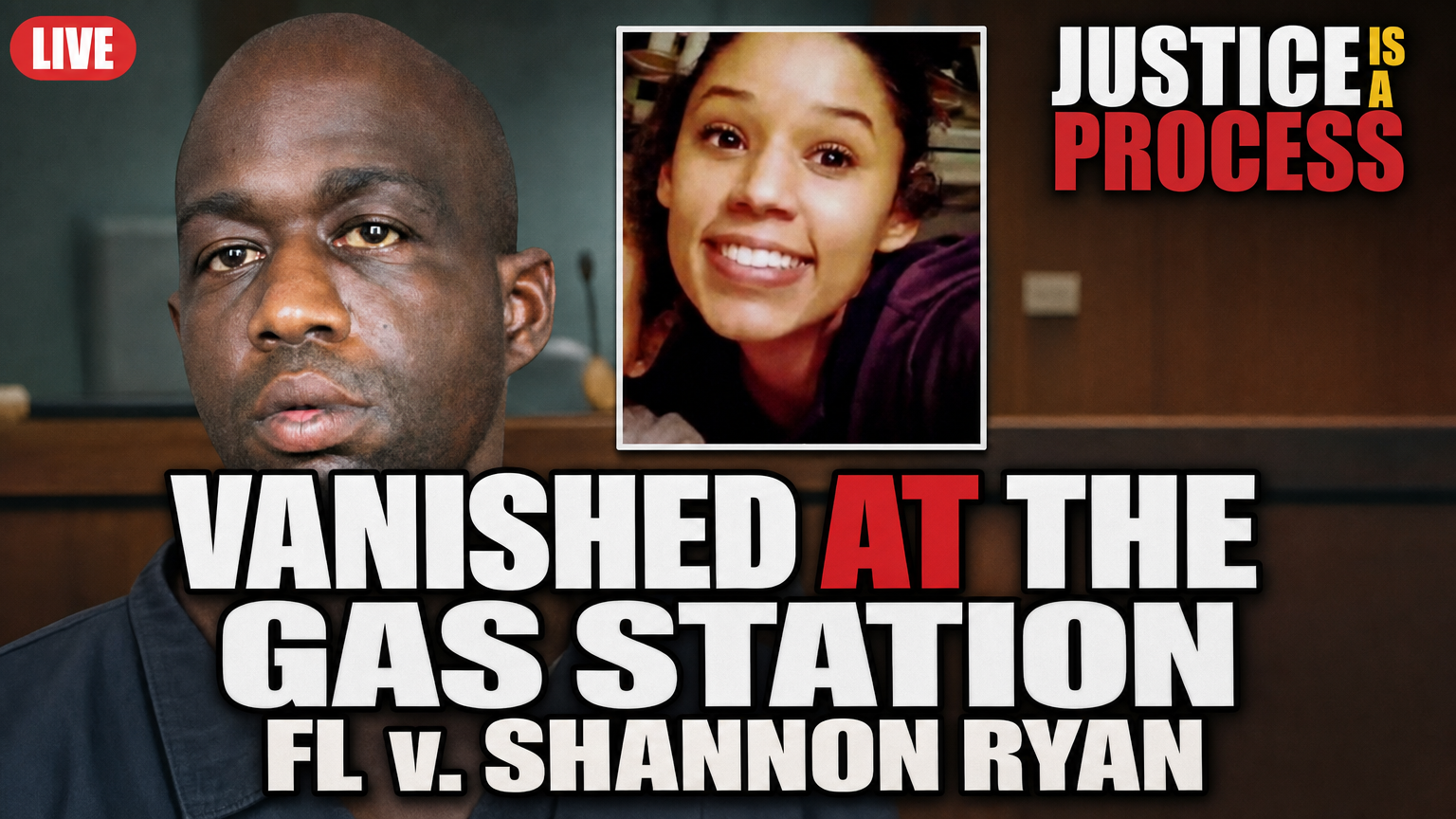
A mother vanished from a gas station. Her toddler was found wandering alone the next morning. Six years later, the man last seen with her goes to trial for murder, with no body ever found.
September 2026 | Justice Is A Process
On the night of July 25th, 2020, twenty-one-year-old Leila Cavett was captured on a gas station security camera in Hollywood, Florida, sitting in the passenger seat of a gold Lexus. She had driven down from Georgia two days earlier. She had a two-year-old son with her, and a white pickup truck she was hoping to sell.
She has not been seen since.
The next morning, a woman at a nearby apartment complex in Miramar found Leila's toddler wandering alone in the parking lot, in nothing but a shirt and a diaper. No mother. No explanation. Just a small child who could not tell anyone what had happened to him.
Six years later, the man who was driving that gold Lexus, a self-described spiritual teacher and tarot instructor named Shannon Ryan, is set to stand trial for Leila's murder. There is no confession. There is no cause of death. There is no body. There has never been a body, despite an FBI search of a South Florida landfill that turned up nothing. What there is, according to investigators, is surveillance video, a discarded pickup truck, a trail of receipts for cleaning supplies and garbage bags, and a Google search history that asked whether bleach and alcohol make chloroform.
Ryan says he is innocent. He says Leila and her son got into a car with a group of men he did not know, and that he had nothing to do with whatever happened after that. The State says the video tells a different story, and that Shannon Ryan is the last person anyone can prove was with Leila Cavett before she disappeared from the face of the earth.
This is Justice Is A Process. We are not here to convict Shannon Ryan and we are not here to acquit him. We are here to watch whether a jury of twelve strangers, presented with a case built entirely on inference and circumstance, can find proof beyond a reasonable doubt that a woman is dead, that this man killed her, and that he then spent the next several days trying to make sure nobody would ever find out. That is an enormous thing to ask twelve people to decide with no body in evidence. Let's begin.
Leila Cavett was twenty-one years old in the summer of 2020, living and working in the Atlanta, Georgia area. Those who knew her describe a young woman still finding her footing in adulthood: a mother to a toddler son, someone trying to make ends meet, someone curious enough about the world to go looking for meaning in unconventional places. According to messages later recovered by investigators, Leila had connected with Shannon Ryan the year before, in 2019, after the two met in Alabama. Ryan taught tarot card reading and described himself online as a spiritual teacher; he advertised witchcraft lessons for roughly a hundred dollars a session. Leila, by her own written words, wanted to become his apprentice.
In July of 2020, Leila made the drive from Georgia to South Florida with her son. Ryan would later tell police the trip was about a truck sale: Leila owned a white pickup truck and wanted to sell it, and he says he gave her three thousand dollars in cash for it. But the Facebook messages investigators recovered tell a fuller story, one in which the truck sale was, at most, part of the reason Leila made that drive. She had told Ryan she wanted to learn from him. She was, in the language investigators would later use, trying to become his student.
Whatever combination of reasons brought her south, Leila Cavett arrived in the Hollywood, Florida area in late July 2020 with her toddler son. Within days, she was gone.
The last confirmed sighting of Leila Cavett comes from surveillance footage at a RaceTrac gas station in Hollywood on the night of July 25th, 2020. That footage shows her in the passenger seat of a gold Lexus that investigators would trace to Shannon Ryan. It is, as far as the public record shows, the last time any camera, any witness, or any documented source places Leila Cavett anywhere on earth.
Ryan's own account of that night, given to police, does not match what the video shows. He told investigators that he saw Leila and her son get into a car with a group of men he did not know, and that he assumed they had gone off with those men. Investigators say the surveillance footage does not support that story. It shows Leila with Ryan, not with a group of strangers.
The following morning, July 26th, 2020, a resident at an apartment complex in Miramar, Florida spotted a small child wandering alone in the parking lot. He was Leila's two-year-old son. He was in a shirt and a diaper, with no adult in sight, no explanation, and obviously no ability to tell anyone what had happened to his mother. The resident called authorities. Leila's white pickup truck was later located in the Hollywood area, but Leila herself was nowhere to be found.
What followed was, in investigators' own telling, a trail of behavior from Shannon Ryan that looked less like a man who had lost track of an acquaintance and more like a man cleaning up after something. Gas station surveillance from the days after Leila's disappearance reportedly shows Ryan returning to the RaceTrac with a bottle of bleach, moving back and forth between Leila's white truck and a nearby dumpster, and at one point dragging a large garbage bag to that dumpster. Investigators say the footage appears to show him discarding items that included women's clothing, a child's belongings, and towels that appeared to be bloodied. The morning after the child was found, according to court records cited by local reporters, Ryan purchased carpet deodorizer, trash bags, and duct tape, some accounts say using Leila's own debit card to do it.
Then there is the search history. According to investigators, a device tied to Ryan was used to search: does bleach and alcohol make chloroform. It is the kind of detail that, once it becomes public, is almost impossible for an audience to un-hear. It is also, importantly, not proof of anything by itself. A search query is not a confession, and the State will have to connect it to what actually happened to Leila Cavett, not just to what Shannon Ryan may have been curious about.
The FBI became involved early, working alongside Hollywood Police and Broward County investigators. Agents say they connected Ryan to Leila's disappearance through a combination of surveillance video, cell tower records, and social media messages, including the Facebook exchanges that documented Leila's plan to study witchcraft under Ryan. The FBI has also conducted multiple searches of a South Florida landfill, reportedly the one that received trash originating from the RaceTrac dumpster Ryan was seen near, in an effort to locate Leila's remains. Those searches, spanning years, have not produced a body. The FBI has offered a reward of up to ten thousand dollars for information leading to the discovery of Leila's location.
Leila Cavett's body has never been found. Six years after she vanished, that fact remains the single most important, unresolved element of this entire case, and it will shape nearly everything that happens inside a Broward County courtroom.
Leila Cavett was twenty-one, a mother, and by every account a young woman still building her life when she disappeared. She is remembered by her family not as a headline or a case number, but as a daughter and a mother whose absence has now stretched past half a decade with no resolution and no remains to bury. Her father, Curtis Cavett, has spoken publicly and directly to the man charged with killing his daughter, telling him: "You took something that was really precious to me," and "you stole my child, and you will suffer for what you did." Those are the words of a father who has spent six years without answers, without a body to grieve over, and without the basic closure that most families in his position are eventually given.
Leila's toddler son survived. He was found alive, if frightened and alone, the morning after his mother vanished. Justice Is A Process will not name him, picture him, or use his story as a hook for this coverage at any point during this trial. He was a small child who lost his mother in the worst possible way, and he deserves to grow up without his name permanently attached to the darkest chapter of his family's history. Any reference to him in our coverage will describe him only as Leila's toddler son.
Shannon Demar Ryan was thirty-nine years old at the time Florida prosecutors charged him with murder in 2021, meaning he is now in his mid-forties. He described himself publicly as a spiritual teacher, a tarot card instructor, and, in the language much of the press has since adopted, a self-proclaimed witch or witch doctor. That framing belongs to reporters and, in some cases, to Ryan's own public self-description; it is not a finding of fact about what happened to Leila Cavett, and Justice Is A Process will not use it as this case's defining label without a clearer editorial basis than a press nickname. Ryan met Leila in Alabama in 2019, after she arrived at his home with her son, and the relationship that followed appears to have combined tarot instruction, witchcraft lessons he charged roughly a hundred dollars a session for, and, per Leila's own messages, her stated wish to become his apprentice.
Ryan has been in custody, held without bond, since Florida filed murder charges against him in May 2021. Before that, he had already spent months in federal custody on a separate kidnapping charge tied to the same disappearance, a charge federal prosecutors ultimately dropped in April 2021 without public explanation, clearing the way for the state murder charge that followed weeks later. When a Miami-area television reporter asked him about the case from a Broward County jail in 2022, Ryan offered little: "I can't go into the particulars of the case like that because this is being recorded, but me and her had previous acquaintances together." He has pleaded not guilty to every charge against him and remains, as a matter of law, presumed innocent until and unless a jury finds otherwise.
This case is being prosecuted by the Broward County State Attorney's Office. As of this report, the specific line prosecutors assigned to try the case, Ryan's defense counsel of record, and the trial judge have not been confirmed through the public reporting available to us. Justice Is A Process will identify each of these parties by name once they are confirmed against the courtroom record or the Broward County docket, and not before. What is confirmed is that Ryan has had defense representation throughout the pretrial process, that his defense team has secured multiple continuances since his 2021 arraignment, and that both sides have spent years litigating access to physical evidence, including hearings held in June 2025 specifically to allow inspection of that evidence.
Shannon Ryan was charged with three counts arising from Leila Cavett's disappearance and presumed death. Florida prosecutors filed these charges in May 2021, after federal authorities dropped an earlier kidnapping charge against him. He was arraigned on May 26th, 2021, and pleaded not guilty to all three. On September 14, 2026, mid-trial, the State dropped the tampering with physical evidence and child neglect counts; second-degree murder is the only remaining count.
What it means: Florida's second-degree murder statute does not require the State to prove Ryan planned Leila's death in advance, the way a first-degree premeditated murder charge would. Instead, prosecutors must prove the killing was committed with what the law calls "a depraved mind regardless of human life," an unlawful killing done through an act imminently dangerous to another and evincing a depraved mind, without premeditation, but also without any legal justification like self-defense.
What the State must prove: That Leila Cavett is dead. That Shannon Ryan caused her death. That the act causing her death was imminently dangerous to another person and demonstrated a depraved indifference to human life. Proving the first element alone, that Leila is dead at all, is unusually difficult in a case with no recovered body and no established cause of death.
Potential sentence: Second-degree murder is a first-degree felony in Florida, punishable by up to life in prison. Absent a downward departure, Florida's sentencing guidelines call for a minimum of roughly sixteen and three-quarter years, with a maximum of life.
What it means: This charge accuses Ryan of altering, destroying, concealing, or removing evidence, knowing that a criminal investigation was pending or about to begin, with the purpose of keeping that evidence out of investigators' hands. This is the charge most directly tied to the surveillance footage investigators say shows Ryan discarding items at the RaceTrac dumpster and purchasing bleach, trash bags, and duct tape in the days after Leila vanished.
What the State must prove: That Ryan knew an investigation was pending or about to be instituted, and that he knowingly altered, destroyed, concealed, or removed evidence with intent to impair its availability.
Potential sentence: Tampering with physical evidence is ordinarily a third-degree felony in Florida, punishable by up to five years in prison.
What it means: This charge accuses Ryan of failing to provide Leila's toddler son with the care and supervision a child requires, specifically tied to the child being left alone, unsupervised, and unable to care for himself, in the parking lot where he was found the morning after Leila disappeared.
What the State must prove: That Ryan acted as a caregiver to the child, and that he willfully or through culpable negligence failed to provide the supervision or care a child of that age requires, without causing great bodily harm, permanent disability, or permanent disfigurement.
Potential sentence: Child neglect without great bodily harm is a third-degree felony in Florida, punishable by up to five years in prison.
The burden of proof rests entirely on the State of Florida, on the remaining murder count. Shannon Ryan does not have to prove his innocence, testify, present a defense, or explain his own version of events. Under the Constitution, he is presumed innocent unless and until twelve jurors unanimously agree the State has proven every element of a given charge beyond a reasonable doubt. That is true no matter how the surveillance footage looks, no matter what his internet search history shows, and no matter how the press has chosen to describe him.
Most murder trials center on a dispute over who did it, or why, or whether the killing was justified. This one starts a step earlier than that. Before a jury can decide whether Shannon Ryan killed Leila Cavett, it first has to decide whether the State has proven, beyond a reasonable doubt, that Leila Cavett is dead at all, and that whatever happened to her was a crime rather than a disappearance the State cannot fully explain. That is the legal concept lawyers call corpus delicti, literally "the body of the crime," and it is not automatically satisfied just because someone has not been seen in six years. Courts can and do convict people of murder without a recovered body, but the State has to build that proof through circumstantial evidence strong enough to eliminate any reasonable doubt that the person is alive somewhere, or that someone other than the defendant is responsible.
That is the core fight at the center of this case. The State's theory, built from the public record so far, appears to be that the surveillance footage, the discarded items, the cleaning supplies, and the search history together tell a story: Leila Cavett died in Shannon Ryan's presence or at his hands on the night of July 25th, 2020, and Ryan spent the days that followed trying to erase the evidence of what happened. The defense, based on what is publicly known, has not laid out a detailed alternative theory, but Ryan's own statement to police, that Leila and her son left with a group of men he did not recognize, previews at least the outline of a defense built on reasonable doubt: that the State cannot prove what actually happened after that gas station video ends, that circumstantial evidence of a cover-up is not the same thing as proof of a killing, and that six years without a body, a cause of death, or forensic evidence connecting Ryan to a specific act of violence leaves real, unresolved gaps in the State's case.
There is also a quieter tension worth naming honestly. The State charged Ryan with second-degree murder, not first-degree premeditated murder, even though some of the alleged evidence, like the internet search for how to make chloroform, could be read as suggesting some degree of advance thought. That charging decision may reflect the practical reality of a case built entirely on circumstantial evidence: without a body, a cause of death, or a clear window into exactly what happened between Ryan and Leila that night, proving premeditation beyond a reasonable doubt would likely be even harder than proving the elements of second-degree murder. It could also reflect prosecutors' read of what the evidence actually shows about how Leila died. Justice Is A Process will be watching for which of those readings the trial record supports, and will not assume either one before the evidence is presented.
Based on the public record built since 2020, the State's case rests on a chain of circumstantial evidence: surveillance video placing Leila with Ryan at the last moment she was ever seen, Ryan's own account of that night contradicted by that same video, a pattern of purchases and discarded items in the days immediately following her disappearance, cell tower data and social media records the FBI says tie Ryan to the timeline, and a search history investigators say points toward Ryan researching how to erase evidence of violence. None of that is a confession, and none of it is a body. It is a case that will likely rise or fall on whether jurors find that circumstantial chain strong enough to eliminate reasonable doubt.
Ryan's defense has not, as far as the public record shows, filed or argued a detailed alternative theory of what happened to Leila Cavett. What is known is that Ryan told police a version of events, involving Leila and her son leaving with unidentified men, that investigators say the surveillance footage does not support. Whether that account survives, gets revised, or gets abandoned entirely once the case reaches trial is one of the central things Justice Is A Process will be watching for. The defense has also spent years litigating access to and inspection of the State's physical evidence, including hearings held as recently as June 2025, which suggests a defense strategy built around testing every piece of the State's circumstantial case rather than offering a competing narrative.
It is worth pausing on what "no body" actually means as a matter of law, because the phrase gets thrown around loosely in true crime coverage and it does not mean what a lot of viewers assume it means. Corpus delicti, the Latin phrase that gets translated as "body of the crime," does not literally refer to a corpse. It refers to the requirement that the State prove a crime actually happened before anyone can be convicted of committing it. In a murder case, that means the State has to prove someone is dead and that the death was caused by a criminal act, not that investigators have to physically produce the victim's remains in a courtroom.
Florida law, like the law in most states, allows prosecutors to establish corpus delicti through circumstantial evidence alone. Courts have recognized for well over a century that murderers who successfully dispose of a body should not automatically escape prosecution simply because they were thorough about it; if that were the rule, hiding a body well enough would function as its own defense. Nationally, no-body murder prosecutions are not the rare long shots that popular imagination often assumes. More than five hundred no-body murder trials have been held in the United States since the 1840s, and by some tallies, roughly eighty-six percent of the ones that reach a jury end in a conviction, a rate that is actually higher than for murder trials generally. That statistic should not be read as a prediction about this specific case. It should be read as context for why the State believes it can bring a case like this to trial at all, and why juries have historically been willing to convict on strong circumstantial evidence even without a recovered victim.
One additional wrinkle of Florida's corpus delicti rule matters less here than it might in another case: Florida requires that before an extrajudicial confession can be admitted into evidence, the State must first establish, independently of that confession, that a crime actually occurred. Because there is no reported confession from Shannon Ryan in this case, that particular safeguard is unlikely to be a major battleground. What will matter is the more basic version of the same principle: can the State's circumstantial evidence, standing on its own, convince twelve jurors beyond a reasonable doubt that Leila Cavett is dead, that her death was a homicide, and that Shannon Ryan is the person responsible? Everything else in this trial sits downstream of that question.
This case has moved unusually slowly, even by the standards of complex circumstantial murder prosecutions. Ryan's trial was originally expected to begin as early as August 2023; it did not. Pretrial hearings and depositions continued through late 2023, continuances pushed the case through 2024, and hearings specifically addressing inspection of physical evidence were held in June 2025. As of this report, the case is expected to reach jury selection in September 2026, more than five years after Ryan was first charged and more than six years after Leila Cavett disappeared. Justice Is A Process has not identified any public reporting on suppression motions, rulings excluding or admitting specific evidence, or other substantive pretrial legal battles beyond the continuances and the evidence-inspection hearings noted above; we will update this report and our daily coverage as that record develops.
This case sits squarely on one of the hardest questions the American justice system can be asked to answer: can the State prove, beyond a reasonable doubt, that a person is dead and that a specific defendant killed her, when there is no body, no established cause of death, and no confession? Courts allow convictions built entirely on circumstantial evidence, and they should, because plenty of real killers make sure a body is never found precisely so they can escape accountability. But that same principle is exactly why the burden of proof matters so much here. A jury that convicts on a thin circumstantial chain sets a precedent that reasonable doubt can be satisfied by suspicion and bad behavior alone. A jury that acquits because the State could not clear that bar, even in a case with genuinely disturbing circumstantial evidence, is doing exactly what the Constitution asks jurors to do.
We will be watching whether the State can connect its circumstantial evidence into an actual chain, rather than a collection of suspicious facts that never quite closes the loop. A search history asking about chloroform is disturbing. It is not, by itself, proof that Leila Cavett died from chloroform, or that Ryan used it on her, or that her death was even caused by another person rather than an accident, an unrelated crime by someone else, or circumstances the record has not yet revealed. We will be watching how the defense handles Ryan's own prior statement to police, the one investigators say the surveillance video contradicts, because a defendant's own inconsistent account of the night in question is often one of the most powerful pieces of evidence a jury hears, for better or worse. And we will be watching whether Leila's family, after six years without a body, without a funeral, and without a definitive answer, gets something closer to resolution than they have had since July of 2020, regardless of which way the jury ultimately rules.
Throughout all of it, we will hold the same standard we hold in every case we cover: the defendant is presumed innocent until the State proves otherwise, to a unanimous jury, beyond a reasonable doubt. That presumption does not evaporate because the underlying facts are disturbing. It exists specifically for cases like this one, where public suspicion runs high and the evidence is genuinely unsettling, because that is exactly when the system is most tempted to cut corners on the burden of proof.
There is a second, quieter principle at stake here too, one that has nothing to do with whether Shannon Ryan is guilty. It is about what this case demands of a jury system built for a much more common kind of trial. Most murder cases give jurors a body, an autopsy report, a cause of death, sometimes a confession. This case gives them none of that. It asks twelve ordinary people to reconstruct, from security camera footage, receipts, and a search history, what happened to a young mother they will never be able to see evidence of in the most literal sense. That is an enormous cognitive and moral burden to place on a jury, and it is worth remembering that the difficulty of that task falls just as heavily on jurors inclined to acquit as it does on jurors inclined to convict. Reasonable doubt is not a formality in a case like this one. It may be the entire ballgame.
A note on dates: Public reporting consistently points to a September 2026 trial date for this case, and Broward County's own published criminal trial-week calendar lists the week of September 14th through 18th, 2026 as a scheduled trial week. However, Justice Is A Process has not found a press or docket source confirming September 14th by name as this specific case's jury selection date, and the exact courtroom start time has not been confirmed anywhere in the public record. We will verify the date, time, and courtroom before our coverage begins, and we will say so plainly if anything changes.
Live broadcasts. No Breaks editions. Justice Breakdowns after each day in court.
The defendant is presumed innocent until proven guilty beyond a reasonable doubt.
Let's watch the system together.
Subscribe to Justice Is A Process on YouTube for live trial coverage, No Breaks editions, and breaking news as it happens.
🔴 Subscribe on YouTube86,000+ subscribers watching the system with us
Discussion