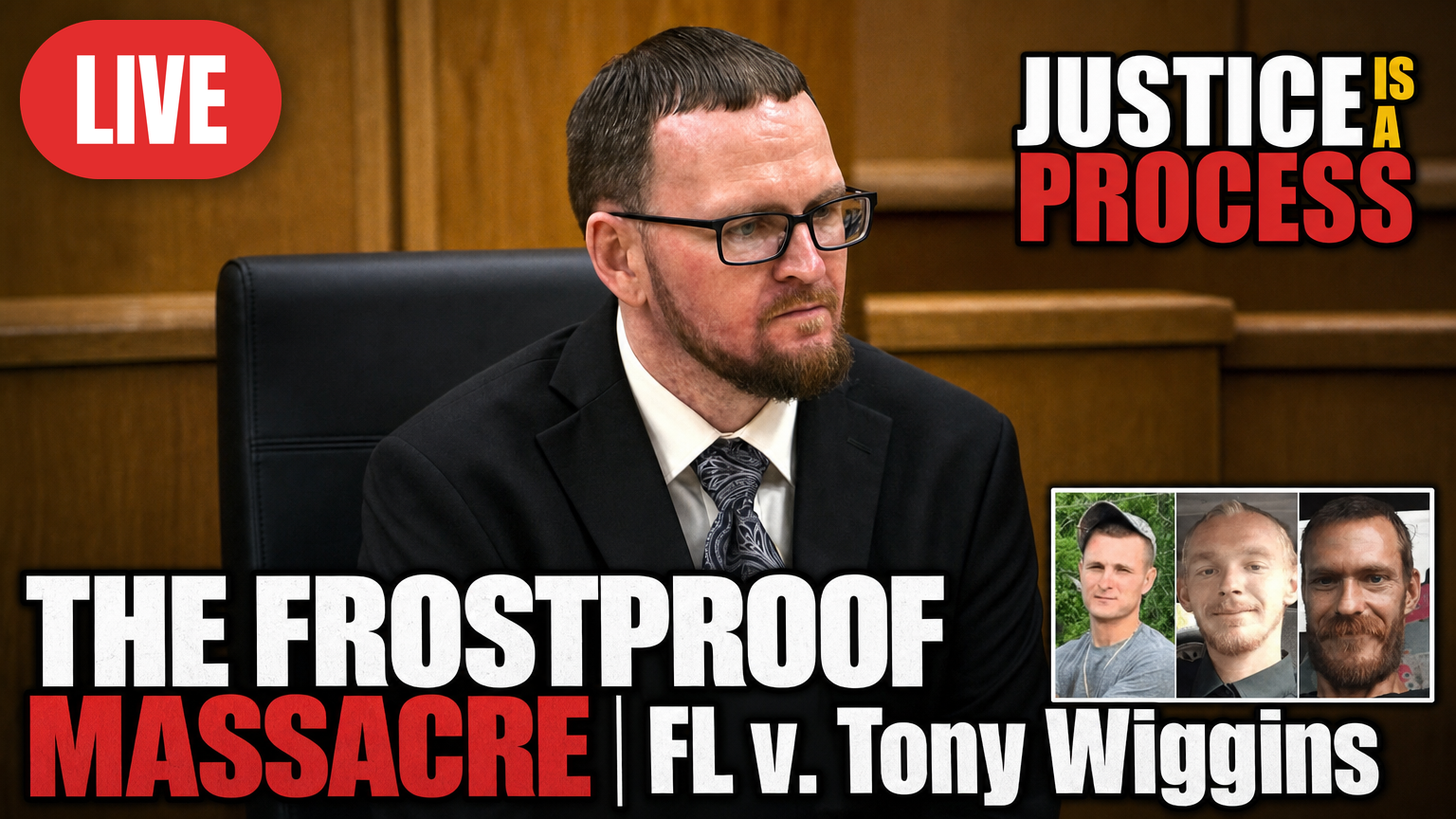
The Frostproof fishing trip massacre — three friends dead, a career criminal on bond, and a death penalty case six years in the making
September 2026 | Justice Is A Process
Brandon Rollins got one word out to his father: "Help."
That was it. That was the call. On a dirt road cut through the scrub off Lake Streety Road, outside a town called Frostproof that most of Florida couldn't find on a map, a twenty-seven-year-old man dialed his father's number with whatever strength he had left and said the only word that mattered. By the time his father got there, two of his son's closest friends were already dead. Brandon held on a little longer. He did not survive the night.
The night before, three men had made plans to go night fishing. That is the whole of what they did wrong, if you believe the State's case: Damion Tillman, twenty-three, Keven Springfield, thirty, and Brandon Rollins, twenty-seven, packed poles and headed for a lake outside Frostproof, a small Polk County town built on citrus groves and quiet. They never got a line in the water. Investigators say they were ambushed, beaten, and shot to death within minutes of arriving, one after another, by a man prosecutors call the shooter: Tony "TJ" Wiggins.
Six years later, Wiggins is on trial for his life. Jury selection opened in Bartow the week of September 8, 2026, in front of the Polk County Courthouse — six years, one federal gun case, two co-defendant plea deals, and a small library's worth of continuances after the killings themselves. The State is seeking the death penalty. Wiggins has pleaded not guilty. Everything in this report describes allegations the State must still prove, beyond a reasonable doubt, to a jury that as of this writing has not yet been seated.
This is Justice Is A Process. Let's begin.
Frostproof is not a place that expects to end up in a headline like this one. It is a small town of a few thousand people in the citrus country of southern Polk County, the kind of place where a triple homicide does not become a true-crime footnote, it becomes something the whole community carries for years. Six years, in this case. Six years in which the town kept its name in the news for reasons no one there wanted, while the case against the man accused of killing three of its own worked its way through continuances, a federal detour, and two co-defendants who each, eventually, admitted to a piece of what happened and walked away with a plea deal instead of a trial. Only one man is left standing in front of a jury. This is his story, told the way this channel tells every story: from the public record, presuming nothing proven until it is proven, and watching the system as closely as we watch the defendant.
According to the Polk County Sheriff's Office, the sequence began at a Dollar General store, not a lake. On the evening of Friday, July 17, 2020, Damion Tillman stopped in and, in the kind of small talk that means nothing until it means everything, mentioned to a store clerk that he was on his way to meet Keven Springfield for a night of fishing. Surveillance footage later reviewed by investigators placed Tony Wiggins, his brother Robert, and Wiggins' girlfriend Mary Whittemore in the same store at the same time.
Investigators allege that what Wiggins overheard set the rest of the night in motion. Prosecutors say Wiggins believed Springfield had stolen the engine out of his truck and sold it — a grudge, authorities allege, that had been building before that night. According to the Sheriff's account, Wiggins directed his brother, who was driving, to follow the men's trucks out to a stretch of dirt road off Lake Streety Road, a spot locals use to launch onto the lake after dark.
Tillman arrived first, in a red pickup. Investigators say he was beaten and shot before Springfield and Rollins even pulled in behind him in a white truck. When they arrived, prosecutors allege, Wiggins confronted Springfield directly over the truck engine, punched him, and then opened fire on all three men. Robert Wiggins, according to investigators, did not fire a weapon himself but helped move Tillman's body into the bed of a truck afterward. The three suspects then drove to a McDonald's. The next morning, investigators say, Robert washed clay from the wheels of his vehicle.
Two of the three victims died at the scene. Rollins did not. He managed to call his father, who drove out to the lake and found his son clinging to life beside his two dead friends. Rollins died from his injuries.
What makes the State's account of that night particularly hard to look away from is how little time separates the ordinary from the fatal. Investigators say the entire sequence — from a passing comment about a fishing trip inside a Dollar General to three men dead on a dirt road — played out over less than an hour. There was no manhunt across county lines, no days-long standoff, no mystery about where the accused had gone. Prosecutors allege the men responsible for the killings ordered fast food afterward and went home. That combination — the banality of the aftermath set against the violence of the act itself — is part of why Sheriff Judd's office reached for the word "massacre" when it briefed reporters, and part of why the case drew statewide attention within days of the bodies being found.
Polk County Sheriff Grady Judd, whose office led the investigation, did not mince words when announcing the arrests five days later, on July 22, 2020. "He's a thug, he's a criminal," Judd said of Wiggins. "He's pure evil in the flesh. He's wild and he's out of control." Judd told reporters his office's goal was for the State Attorney to be able to seek the death penalty.
All three suspects were taken into custody within days: Tony Wiggins, then 26; his brother, William "Robert" Wiggins, then 21; and Wiggins' girlfriend, Mary Whittemore, then 27. Wiggins was indicted on three counts of first-degree murder that September. All three defendants pleaded not guilty and were held in the Polk County Jail as the case began what would become a years-long march toward trial.
Investigators have said the case against Wiggins leans on more than one kind of evidence: surveillance footage placing the three defendants in the same store as the victims minutes before the killings, physical evidence recovered from the scene on Lake Streety Road, and, eventually, the sworn account of his own brother, who was in the vehicle throughout. None of that is a substitute for a jury's verdict, and none of it has been tested yet by cross-examination in front of the jury that will actually decide this case. It is, however, the shape of the case the State has been building since the week of the killings, and it is the shape this trial will test.
Before they were case numbers, they were three friends who fished together. Damion Tillman was 23. Keven Springfield was 30. Brandon Rollins was 27, according to the most detailed account of the case reviewed for this report — though at least one other outlet has reported his age as 28, a discrepancy this newsroom has not been able to independently resolve from a public charging document and will correct on air if the courtroom record settles it differently. What is not in dispute is who they were to each other: not strangers caught in someone else's crossfire, but a small, tight circle of friends who had made a plan as ordinary as it gets — meet up, grab poles, go catch something before the sun came up.
Frostproof is a town of a few thousand people in rural Polk County, the kind of place where a triple homicide does not stay a headline, it becomes something the whole community carries. Public donations covered funeral costs for the three men in the weeks after the killings — a detail that says as much about how the community responded as anything a prosecutor could argue in a courtroom. In the days after the killings, one of the victims' mothers told reporters plainly that she believed the man accused of killing her son deserved the death penalty — a mother's grief speaking in a moment before any courtroom had tested the State's case, and exactly the kind of raw, human reaction this channel does not shy away from covering even while it holds the legal presumption of innocence separately and seriously.
What the public record does not offer, six years on, is much biography beyond the fact of their deaths and the manner of them: three men, ages 23, 27, and 30 at the time, friends enough to plan a night of fishing together, on a stretch of Polk County lake country where that kind of plan is about as unremarkable as plans get. As trial testimony unfolds, Justice Is A Process will look for and report the fuller human portraits of Damion Tillman, Keven Springfield, and Brandon Rollins that a courtroom, unlike a wire report, tends to surface — through the words of family members who take the stand, victim-impact statements, and the testimony of the people who knew them before any of this happened. They do not deserve to be remembered only as the three names attached to someone else's charge sheet, and this coverage will not treat them that way.
Tony Wiggins was 26 years old at the time of his arrest, born February 25, 1994. According to reporting on his criminal record, by that point in his life he had already accumulated roughly 230 felony charges and 15 convictions across two prison sentences, with arrests dating back to age 12. At the moment prosecutors say he opened fire at Lake Streety Road, Wiggins was out on bond — not for a minor offense, but for an aggravated battery charge stemming from an earlier incident in which he is accused of breaking a man's arm with a crowbar.
That fact belongs to the story this case tells about the system itself as much as it belongs to the story about what happened at the lake, and Justice Is A Process will be asking the same question its audience will be asking: how does a defendant with that record end up free on bond at all, and what, if anything, changes about how that question gets asked once someone is dead. None of that record proves what happened on July 17, 2020. Wiggins has pleaded not guilty to the murder charges, and the presumption of innocence he is owed by the Constitution does not shrink because of what came before. It is, however, the context the State will lean on, and the context this channel will not pretend does not exist.
This case started with three defendants. Only one of them — Tony Wiggins — is on trial for murder, and only he faces the death penalty. That distinction matters enough to state plainly, because it is easy for a case this old, with this many names attached to it, to blur into one undifferentiated story of guilt. It is not one story. It is one man on trial for his life, and two people who admitted to a much smaller piece of it years ago.
Robert Wiggins, Tony's younger brother, was never charged with pulling a trigger. He faced tampering with evidence and three counts of accessory after the fact to a capital felony — the allegation that he drove the vehicle that followed the victims to the lake and helped move a body afterward, not that he shot anyone. In April 2024, he signed a plea agreement: five years in state prison with credit for time served, two years of probation, and an obligation to testify against his brother at trial. That December, frustrated that the trial kept slipping while his own sentence sat on hold, he asked the court to let him withdraw the plea. Polk County Circuit Judge J. Kevin Abdoney denied the request on December 4, 2024, though the judge noted that if the delays stretched dramatically longer, the calculus could change. Robert Wiggins has a status hearing on the case scheduled for October 23, 2026.
Mary Whittemore, Wiggins' girlfriend at the time, was charged the same way — three counts of accessory after the fact to a capital felony, along with a perjury count tied to her statements during the investigation. She signed a plea agreement and was sentenced in 2024 to four years. Reporting indicates she has since been released, having already served her time by the time her co-defendant brother-in-law was still fighting to get off the case's docket.
Neither Robert Wiggins nor Mary Whittemore is charged with murder. Neither faces the death penalty. Both have already had their cases resolved. Only Tony Wiggins goes to trial for the killings themselves — and when he does, the State's case is expected to lean in part on testimony from the two people who once stood beside him in that Dollar General parking lot, and who cut deals of their own rather than stand trial with him.
There is a version of this case where that distinction gets lost — where "three people were charged" quietly becomes "three people are on trial," and a viewer walks away thinking the defendant's brother and girlfriend are sitting at a defense table beside him. They are not. They already stood in front of a judge, admitted their own roles, and left custody or are counting down toward release. The only person the jury will be asked to judge on the murder counts is Tony Wiggins. Every surface this channel publishes on this case — titles, descriptions, thumbnails — will keep that line drawn clearly, because collapsing it does a disservice to the presumption of innocence Wiggins is owed and to the different, already-resolved facts of his co-defendants' cases alike.
Sheriff Grady Judd of the Polk County Sheriff's Office has been the public face of the investigation from the first press conference in 2020 forward, though he is not the case's lead detective and this report does not name one — that detail was not confirmed in public reporting reviewed for this piece and will be corrected on air once the courtroom record supplies it. The presiding judge for pretrial matters has been Circuit Judge J. Kevin Abdoney of Florida's Tenth Judicial Circuit; whether he remains the trial judge will be confirmed as coverage begins. The prosecution and defense trial teams had not been named in public reporting available at the time this report was written.
Tony Wiggins faces three counts of first-degree murder, one for each of the three men killed at Lake Streety Road, plus tampering with evidence and two counts related to firearm and ammunition possession by a convicted felon.
What it means: Under Florida law, first-degree murder is the unlawful killing of a human being when the killing is premeditated — planned, even if only in the moments before it happens — or committed during certain other felonies. It is Florida's most serious homicide charge, and the only charge in this case that carries the death penalty.
What the State must prove, for each count: That the named victim is dead; that Wiggins caused the death; that the killing was unlawful; and that it was premeditated — that Wiggins formed the intent to kill before he acted, even briefly, rather than the death resulting from a sudden, unplanned confrontation.
Potential sentence: Death or life in prison without the possibility of parole. Under current Florida law, a jury need not be unanimous to recommend a death sentence — at least eight of twelve jurors agreeing is enough, provided the jury is unanimous on guilt itself and unanimous that at least one aggravating factor applies. More on that below.
The burden: Entirely on the State, for every count, beyond a reasonable doubt. Wiggins does not have to prove anything, testify, or explain himself. The presumption of innocence holds through every count until a jury says otherwise.
What it means: Separate from the murder counts, prosecutors allege Wiggins tampered with evidence connected to the killings, and that — because of his prior felony convictions — he was legally barred from possessing the firearm and ammunition investigators say he used.
What the State must prove: For tampering, that Wiggins altered, destroyed, or concealed evidence with intent to impair an investigation. For the possession counts, that Wiggins had a prior qualifying felony conviction and knowingly possessed a firearm and ammunition despite that disqualification.
Potential sentence: Each is a second- or third-degree felony under Florida law, carrying years, not decades, on its own — though any sentence here is secondary to what a jury decides on the murder counts.
Strip away the six years of continuances and what is left is a case that, on its face, does not look complicated: prosecutors say a man with an extraordinarily long criminal history, free on bond for a violent crime, shot three unarmed men over an argument about a truck engine, in front of his own brother, and the physical and testimonial evidence — from surveillance video to two co-defendants who have already admitted to their own roles — points at him. That is not, however, why this case matters, or why it took six years and a federal detour to get in front of a jury.
It matters because of what the State is actually asking twelve Floridians to do: sentence a man to death based, in real part, on the word of his own brother and his own girlfriend — two people who avoided a capital charge themselves by agreeing to testify against him. Robert Wiggins has already tried, and failed, to get out from under that arrangement once, telling a judge in open court that he felt strung along while his co-defendant walked free years before he did. That is not a defense theory this report is asserting; it is a fact already on the public record, from the defendant's own brother, about the very deal the State needs him to honor at trial. Whatever the defense argues when trial testimony begins, the credibility of the two witnesses closest to Wiggins — and the deals that bought their testimony — will be at the center of it.
It matters, too, because of what happened before the shooting. Wiggins was not a stranger to the system on July 17, 2020. He was inside it, on bond, accused of breaking a man's arm with a crowbar, when three more people ended up dead. That is not a legal defense and it proves nothing about what happened at the lake — but it is exactly the kind of systemic question Justice Is A Process exists to sit with: not just "did he do it," but "how did the system's own decisions about pretrial release intersect with what allegedly happened next."
Prosecutors' theory, as laid out through years of pretrial filings and the original arrest affidavit, is straightforward: Wiggins held a grudge over a stolen and resold truck engine, used a chance encounter at a Dollar General to track down the men he blamed, directed his brother to follow them to an isolated spot, and killed all three when he caught up with them. The State's evidence is expected to include store surveillance footage placing the defendants near the victims before the killings, physical evidence from the scene, and — pending how trial actually unfolds — testimony from Robert Wiggins, who has already admitted under oath to driving the vehicle and helping move Tillman's body afterward.
As of this report, Wiggins' trial defense strategy has not been detailed in public reporting reviewed for this piece. He has pleaded not guilty to all counts. Any suppression motions, evidentiary disputes, or alternate theories his defense team raises once trial testimony begins will be covered here and updated into this record — this report will not guess at a defense that has not yet been made in open court.
Cases this old invite a fair question from any viewer meeting it for the first time: why did it take until 2026 to get a triple-murder case in front of a jury for a crime committed in 2020? Part of the answer is ordinary capital-case timeline — death penalty prosecutions routinely take years longer than other homicide cases because of the heightened stakes, the additional pretrial motions practice, and the extra scrutiny every ruling receives knowing an execution could eventually turn on it. Part of the answer, in this case specifically, is a federal detour that had nothing to do with the killings themselves.
While the state murder case moved through Polk County's courts, federal prosecutors separately indicted Wiggins on charges of possessing ammunition, and later a rifle, as a convicted felon — charges connected to his prior record rather than to the Frostproof killings. A state trial date originally set for July 2024 was postponed after federal authorities declined to transport Wiggins to Polk County for hearings until his federal case concluded, a jurisdictional standoff that pushed the state case back by the better part of a year on its own. Add in the ordinary churn of a years-long capital docket — motions, continuances, a co-defendant's own plea negotiations dragging past their original timeline — and six years stops looking like an anomaly and starts looking like what a modern capital case in a busy circuit actually costs in time. That does not make the wait any easier for the three victims' families, or for Robert Wiggins, who told a judge in 2024 that the delay itself felt like its own punishment while he sat in custody watching a co-defendant walk free years ahead of him.
Florida is not like most death-penalty states anymore, and that fact alone should be part of how anyone watches this trial. In April 2023, the Florida Legislature eliminated the requirement that a jury be unanimous to recommend a death sentence. Under the law as it now stands, a jury must still be unanimous that a defendant is guilty, and unanimous that at least one aggravating factor applies — but only eight of twelve jurors need to agree that death, rather than life without parole, is the appropriate sentence. Florida and Alabama are now the only two death-penalty states in the country that do not require a unanimous jury to impose death, and Florida's threshold is the lowest in the nation. The Florida Supreme Court upheld the law against constitutional challenge as recently as December 2025.
That is the frame Justice Is A Process will be watching this trial through: not just whether the State proves its case beyond a reasonable doubt, but what an 8-4 death recommendation looks like in practice, on a case where a meaningful share of the State's proof may come from two witnesses who avoided the same charge by testifying. We will be watching whether the defense challenges that testimony's reliability, whether Wiggins' own record before this case is allowed in front of the jury and how, and whether the six years of delay — much of it caused by a federal weapons case that had nothing to do with these three deaths — becomes its own subject of dispute before this is over.
We will also be watching the system's other side of the ledger: how Wiggins came to be free on bond, facing a crowbar aggravated-battery charge, at the moment prosecutors say he killed three people. That is not a question a jury will be asked to answer. It is a question this channel intends to keep asking anyway, because the presumption of innocence a defendant is owed in the courtroom does not mean the system that put him on the street beforehand is above examination.
Florida's move to 8-4 death sentencing did not happen in a vacuum, and the history is worth knowing before this trial starts, because it is the exact legal machinery a jury in Bartow will be operating under. For decades, Florida's death penalty scheme was repeatedly struck down and rewritten by courts, most consequentially in the U.S. Supreme Court's 2016 decision in Hurst v. Florida, which found the state's system unconstitutional because it let judges, not juries, make the key factual findings needed to impose death. Florida responded first by requiring unanimous jury findings — bringing it in line with nearly every other death-penalty state. That changed again in 2023, after a Broward County jury declined to unanimously recommend death for Parkland school shooter Nikolas Cruz, who was sentenced to life instead. Within weeks, the Florida Legislature passed, and Governor Ron DeSantis signed, the law lowering the threshold to 8 of 12 jurors. Death-penalty opponents and several legal scholars have argued the law moves Florida further from the national consensus and closer to constitutional vulnerability; the Florida Supreme Court has so far upheld it against every challenge brought, most recently in December 2025.
None of that history decides Tony Wiggins' case. It does mean that if this jury convicts and reaches a sentencing phase, the numbers that matter will not be the "12-0" most Americans assume a death sentence requires — they will be "8-4," the lowest bar in the country, on a case where at least two of the State's own witnesses have personal, deal-driven reasons to want the jury to believe them. Watching whether the defense makes that argument explicitly, and whether it resonates with a Polk County jury, is exactly the kind of "is the system working the way it claims to work" question this channel was built to sit inside.
Live broadcasts. No Breaks editions. Justice Breakdowns every night.
Tony Wiggins is presumed innocent until proven guilty beyond a reasonable doubt.
Let's watch the system together.
Subscribe to Justice Is A Process on YouTube for live trial coverage, No Breaks editions, and breaking news as it happens.
🔴 Subscribe on YouTube86,000+ subscribers watching the system with us
Discussion