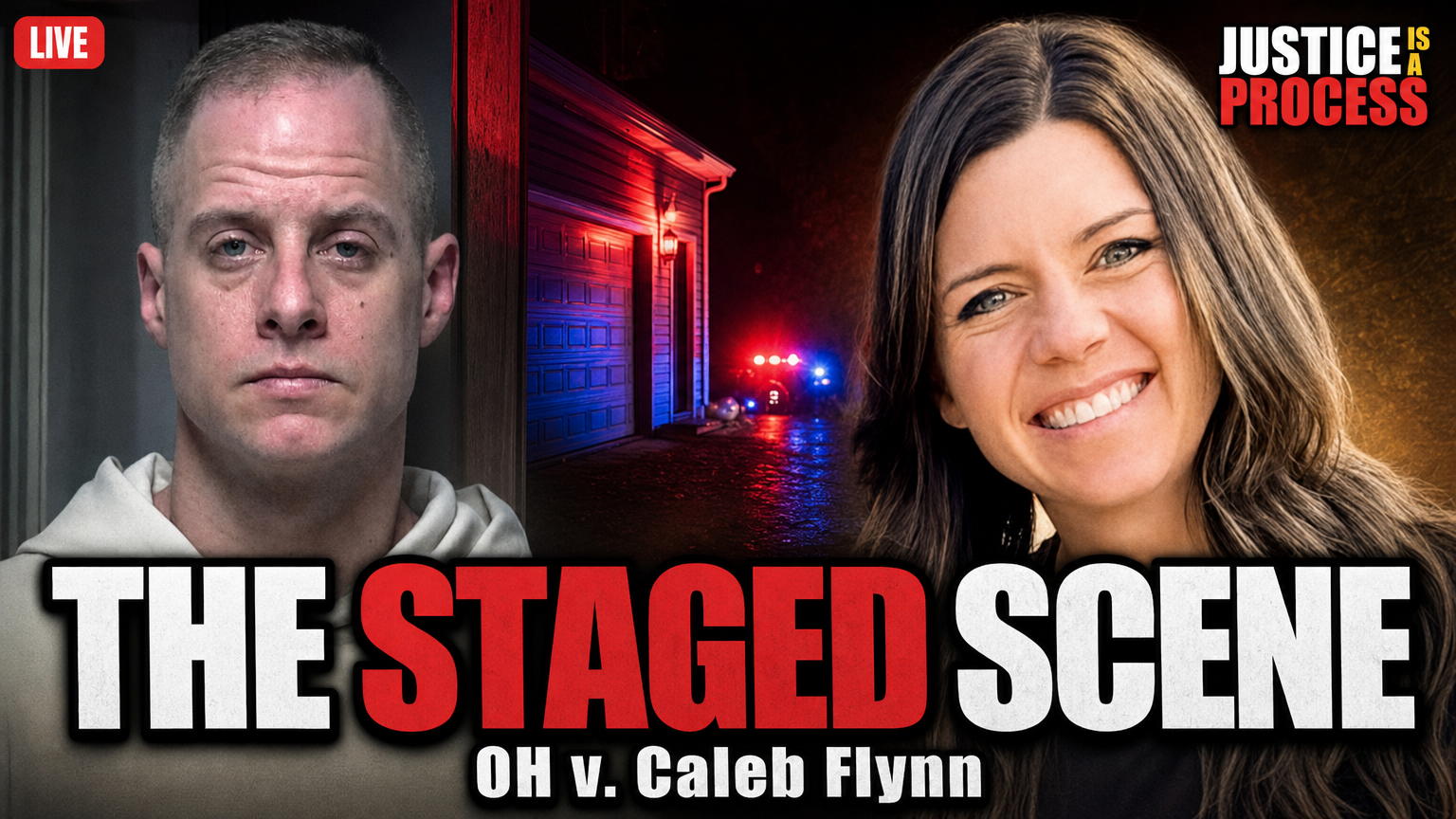
He told 911 an intruder shot his wife. The garage was barricaded from the inside, and a text from his phone that same night read: "It's almost done."
September 2026 | Justice Is A Process
At around 2:30 in the morning on February 16th, 2026, a man in Tipp City, Ohio, called 911 and told the dispatcher that someone had broken into his home and shot his wife. "Somebody broke in my home and shot my wife," he said. "She's got two shots to her head." Upstairs, the couple's two young daughters were asleep. They were unharmed. Downstairs, on the bedroom floor, Ashley Flynn, 37, a volleyball coach and substitute teacher at Tipp City Schools, was dying from gunshot wounds.
The man on the phone was her husband of fifteen years, Caleb Flynn. Some viewers will recognize the name from a different context entirely: in 2013, a much younger Caleb Flynn stood in front of the American Idol judges in Chicago, earned a golden ticket to Hollywood, and was eliminated before the show's live rounds ever began. That is the extent of it. He never sang on national television again. Thirteen years later, he is not being covered because of a reality show. He is being covered because prosecutors in Miami County say the story he told police that night does not match the physical evidence inside his own home, and because a text message pulled from his phone, sent to a woman who was not his wife less than two hours before that 911 call, read: "It's almost done."
According to investigators, the garage door Flynn said the intruder must have used was blocked from the inside by a refrigerator. His own truck, parked in that same garage, had its center console sitting open. Two shell casings recovered from the bedroom floor were 9mm, the same caliber as a handgun Flynn is said to have kept in that truck's glovebox, feet from where his wife lay dying. No forced entry. No missing intruder. Just a locked house, a dead woman, and a story that prosecutors say was staged to explain a scene that could not otherwise explain itself.
Flynn was arrested three days later. A Miami County grand jury indicted him, then indicted him again on a superseding, eleven-count indictment in March: aggravated murder, three counts of murder, two counts of felonious assault, three counts of tampering with evidence, and two misdemeanor counts of witness intimidation. He has pleaded not guilty to every count. His bond, initially set at two million dollars, was raised to three and a half million after the second indictment came down. He is presumed innocent of all of it, and nothing in this report should be read otherwise.
On Thursday, September 17th, 2026, jury selection begins at the historic Miami County Courthouse in Troy, Ohio, before Judge Jeannine N. Pratt. The trial is expected to run roughly two weeks. This is Justice Is A Process. We are not here to convict Caleb Flynn, and we are not here to acquit him. We are here to watch whether the physical evidence the State says proves a staged crime scene actually holds up in front of twelve strangers, under cross-examination, with a man's life and two children's futures on the other end of the verdict. Let's begin.
Tipp City sits in Miami County, Ohio, a small city north of Dayton, the kind of place where a volleyball coach at the local schools is somebody a lot of people know. Ashley Flynn coached at Tipp City Schools and had also worked as a substitute teacher there. She and Caleb Flynn had been married fifteen years and had two daughters together, both of whom were home and asleep at the time of the shooting.
According to the 911 call, Caleb Flynn told the dispatcher that an intruder had broken into the home on Cunningham Court and shot his wife, describing two gunshot wounds to her head. Emergency responders arrived to find Ashley Flynn suffering from gunshot injuries; she did not survive. The two children in the home were not physically harmed.
Cunningham Court is an ordinary residential street in a small Ohio city, the kind of place where a 2:30 AM shooting is not a routine call for local dispatch or patrol. Neighbors and Tipp City Schools families learned within hours that a coach and teacher in their own community was dead, and that her husband, the man who called it in, was the one telling police a stranger had done it. That combination, a familiar face in a small school district and a violent, unexplained death inside her own home, is a large part of why this case drew immediate local and then national attention well before an arrest was made.
What prosecutors allege happened next is the center of this entire case. The State's theory, as reported from search warrant affidavits and court filings, rests on three physical findings inside the home. First, the garage, the point of entry Flynn described to the 911 dispatcher, was reportedly blocked from the inside by a refrigerator, meaning nobody could have entered that way without first moving it, and nobody inside the home reported having done so before help arrived. Second, the center console of Flynn's own truck, parked inside that same garage, was found open. Third, two 9mm shell casings recovered from the bedroom floor were reported to match the caliber of a handgun Flynn is alleged to have kept inside that truck's glovebox.
Taken together, prosecutors argue, those three facts describe a home invasion that could not have physically happened the way Flynn described it on the 911 call, an accessible handgun close enough to explain the two shots, and a homeowner with both the opportunity and, according to the State, a motive investigators say they found on his phone.
Each of the three physical findings does a different piece of work for the prosecution's theory, and it is worth walking through why. A barricaded garage door does not just fail to prove an intruder came through it; if a refrigerator was genuinely blocking that door from the inside at the time officers arrived, it affirmatively rules that entry point out, which matters because Flynn's own 911 account named the garage as where the intruder came from. An open truck console, by itself, proves very little. Paired with a claim that a handgun normally lived inside that console or the glovebox beside it, it becomes a detail investigators say explains how a weapon that should have been secured became immediately accessible. And matching shell casings do the most direct work of all: ballistics testimony, if the casings are confirmed to have been fired from that specific handgun, would tie the weapon in Flynn's truck directly to the two shots that killed his wife. None of these three facts, on its own, proves intent or identity. Together, prosecutors will argue, they describe a scene that was arranged rather than discovered.
Search warrant materials reported by multiple outlets describe messages exchanged between Flynn's phone and a woman in the hours before the shooting, a woman press reporting has described as 23 years old and reportedly pregnant. She has not been named in public reporting, and this report will not name her either; she has not been charged with anything, and there is no public indication she had any advance knowledge of what prosecutors allege Flynn did. The text prosecutors are reported to be relying on, sent from Flynn's phone at 12:42 AM, roughly two hours before the 911 call, read: "It's almost done."
What that text meant is precisely the kind of question a jury, not a headline, is supposed to answer. Prosecutors will argue it describes a plan already in motion. The defense has not, according to available reporting, offered its own account of what those words meant. That gap, a piece of alleged evidence with an obvious prosecutorial reading and no publicly reported defense explanation, is one of the central things this case is going to trial to resolve.
It is worth being precise about what is and is not alleged here. Investigators are not reported to allege that the other woman had any role in the shooting itself, any advance knowledge that it would happen, or any presence at the scene. What is alleged is a timeline: a marriage, a relationship outside that marriage, a pregnancy reported in press coverage, and a text sent from Flynn's own phone hours before his wife was killed. A jury will ultimately decide what connects those facts, if anything, to what happened in that bedroom. This report will not connect them for you.
Flynn was arrested on February 19th, 2026, three days after the shooting. A Miami County grand jury returned an initial indictment, and in March 2026 returned a superseding, eleven-count indictment that added charges beyond the original filing, most notably the tampering-with-evidence and witness-intimidation counts, which suggest investigators developed additional evidence in the weeks between the two indictments rather than resting on what they had at the time of arrest. Bond, initially set at two million dollars, was raised to three and a half million dollars once the superseding indictment was returned, a substantial increase that reflects how the court weighed the added charges against Flynn's flight risk and danger to the community. Flynn has pleaded not guilty to all eleven counts and remains out on bond ahead of trial, subject to whatever release conditions the court has imposed.
Ashley Flynn was 37 years old. She coached volleyball for Tipp City Schools and had also worked as a substitute teacher in the district, meaning she was a known, present figure in a school community that is now grieving her in public. Her obituary describes a woman remembered by students and colleagues alike; the school district itself has publicly mourned her loss. She was a wife of fifteen years and a mother of two daughters. Whatever this trial ultimately determines about how she died, it will not change who she was to the people who knew her: a coach, a teacher, a mother, a woman with fifteen years of marriage and two children who will grow up carrying this. This report will not reduce her to "the victim." She was Ashley Flynn, and this case exists because somebody ended her life.
A volleyball coach occupies a particular place in a school community. She is not a distant administrator; she is somebody's teacher during the day and somebody's coach after school, present at practices, at away games, on bus rides, in the hallways between classes as a substitute. That kind of role means a death like this does not stay contained to one family. It touches a roster of student athletes, their parents, fellow coaches, and colleagues across a district small enough that most people can name at least one person directly affected. Tipp City Schools' own public statements mourning her loss reflect exactly that kind of community-wide grief, not the more distant reaction a stranger's death might draw.
Caleb Flynn is Ashley's husband of fifteen years and the father of their two daughters. Some coverage of this case has led with his brief brush with reality television: in 2013, Flynn auditioned for American Idol's twelfth season, earned a golden ticket to Hollywood during the Chicago audition round, and was eliminated during Hollywood Week, never reaching the show's televised live competition. It is a real, verifiable fact about him, and it is also thirteen years and a lifetime removed from the allegations he now faces. It belongs in the story as a footnote about who he was before any of this, not as a frame for who prosecutors say he is now.
That American Idol footnote is worth naming honestly precisely because it is doing so much work in how this case has spread online. Search interest and social attention, particularly on platforms like TikTok, latched onto the "former American Idol contestant charged with murder" hook well before most of the physical evidence was public. That is a real phenomenon worth acknowledging, and it is also a trap: a case built on a barricaded garage door, matching shell casings, and a phone record deserves to be understood on those terms, not as a celebrity-adjacent curiosity. This channel will use the Idol connection where it is relevant to explaining why the case found an audience, and nowhere else.
Flynn was arrested February 19th, 2026, and has pleaded not guilty to an eleven-count indictment. He is presumed innocent unless and until the State proves every element of every charge against him beyond a reasonable doubt. He is currently out on bond, which was raised from two million to three and a half million dollars after the superseding indictment. Public reporting has not disclosed a defense theory of what actually happened inside that home the night Ashley Flynn died, only a challenge to how the investigation was conducted. What that means for trial is something this report addresses in the Legal Landscape section below.
Defense counsel Patrick Mulligan, of the Dayton firm Moermond & Mulligan, represents Flynn and has been the public voice of the defense in pretrial proceedings. Judge Jeannine N. Pratt presides over the case in Miami County Common Pleas Court. The lead prosecutors and lead investigating detectives have not been confirmed by name in the research available for this report and, per this channel's own naming discipline, will not be printed here until independently verified against the trial record; expect that gap to close once trial testimony begins.
The couple's two daughters are reported to be expected witnesses in this case, and reporting indicates the prosecution has sought special protective measures around how they participate in the proceedings, though the exact accommodation the court has settled on is not yet confirmed from primary sources available for this report. Consistent with this channel's standing rule, no imagery of either child will appear on any surface tied to this coverage, at any point, for any reason. That rule is not a courtesy. It reflects a basic recognition that whatever a jury eventually decides about their father, these two children lost their mother in violent, public circumstances, and nothing this channel produces will add to what they already carry.
Flynn faces eleven counts under a superseding Miami County indictment. Below is what each charge means in plain English, not what the State has proven, because nothing has been proven yet.
Eleven counts sounds overwhelming, and it is meant to communicate the seriousness of what is alleged, but it is worth understanding how Ohio homicide indictments are typically structured before assuming each count represents a separate, independent act. Prosecutors routinely charge multiple counts of murder and aggravated murder covering the same single death, each resting on a different legal theory, purposeful killing, felony murder, prior calculation, precisely so that if a jury rejects one theory but accepts another, a conviction is not lost on a technicality. Those counts almost always merge into a single sentence at sentencing if Flynn is convicted of more than one arising from Ashley Flynn's death. The felonious assault and tampering counts, by contrast, are charging genuinely separate alleged conduct, the act of causing her injuries and the act of concealing or misrepresenting evidence afterward, and could be sentenced independently if proven. The two misdemeanor intimidation counts are the least severe charges on the indictment by a wide margin, but they are not decorative; if proven, they would establish conduct after the fact aimed at a witness, victim, or attorney connected to the case, which can matter to a jury's overall assessment of consciousness of guilt even though it is legally a separate question from whether Flynn caused his wife's death.
What it means: Under Ohio law, aggravated murder is the most serious homicide charge on the books: the State must prove Flynn purposely caused Ashley Flynn's death, and that he did so with prior calculation and design, meaning the killing was planned rather than a sudden, unplanned act.
What the State must prove: That Ashley Flynn is dead, that Flynn caused her death, that he did so purposely, and that he planned it in advance rather than acting in a moment of impulse.
Potential sentence: Ohio does not appear to be pursuing a death penalty specification in this case, per available reporting. Without one, a conviction on aggravated murder in Ohio carries a sentence of life imprisonment, with the specific parole-eligibility tier, anywhere from twenty years to life without parole, determined by the court based on the exact findings in the case.
The burden: Entirely on the State. Flynn does not have to prove anything, including his own innocence.
What it means: Ohio prosecutors frequently charge multiple murder counts alongside an aggravated murder count, each resting on a slightly different legal theory of how the same death occurred, for example, purposeful killing versus a killing that occurred during the commission of another violent felony. These counts typically run alongside, not instead of, Count 1, and would likely merge with it at sentencing if Flynn is convicted on more than one.
What the State must prove: Depending on the specific theory behind each count, that Flynn purposely caused Ashley Flynn's death, or that her death was the proximate result of Flynn committing or attempting to commit a separate felony offense of violence against her.
Potential sentence: Murder under Ohio law carries a sentence of fifteen years to life in prison. As with the murder counts, this would likely merge with Count 1 at sentencing if Flynn is convicted of both.
What it means: Felonious assault charges typically accompany a homicide charge in Ohio when a deadly weapon was used or serious physical harm was knowingly caused, and often serve as the underlying predicate felony for one of the murder counts above.
What the State must prove: That Flynn knowingly caused serious physical harm to Ashley Flynn, or knowingly caused or attempted to cause physical harm to her by means of a deadly weapon.
Potential sentence: Felonious assault in Ohio is typically a second-degree felony, carrying a possible range of two to eight years in prison per count, though the degree and range can shift depending on the specific circumstances charged.
What it means: This is the charge most directly tied to the State's staging theory. Tampering with evidence covers altering, destroying, concealing, or removing evidence with the purpose of impairing its value or availability in an official investigation.
What the State must prove: That Flynn knew an official investigation was likely, and that he altered, destroyed, concealed, or removed evidence, potentially including how the scene itself was arranged, with the purpose of making that evidence look different than it actually was.
Potential sentence: Tampering with evidence is a third-degree felony in Ohio, carrying a possible range of nine to thirty-six months in prison per count.
What it means: This charge covers knowingly attempting, by any unlawful means, to influence, intimidate, or hinder a victim, witness, or attorney involved in a criminal case.
What the State must prove: That Flynn knowingly attempted to influence or intimidate a specific victim, witness, or attorney connected to this case.
Potential sentence: As misdemeanors, these two counts each carry a substantially lower maximum sentence than the felony counts above, typically up to 180 days per count under Ohio's first-degree misdemeanor classification.
This case is at trial because the physical evidence inside that house does not match the story Flynn told 911. A garage door barricaded from the inside. A truck console left open in that same garage. Two shell casings matching a handgun kept feet away. And a text message to another woman, sent less than two hours before the shooting, that reads like an ending rather than a beginning: "It's almost done." That is not one piece of contested evidence. It is a staging case built on three physical facts plus a phone record, and the entire trial will turn on whether that combination proves, beyond a reasonable doubt, that Flynn did what the State says he did.
Prosecutors are expected to argue that the crime scene was arranged to look like a home invasion that could not have physically occurred as described, that Flynn had both access to the murder weapon and, through the phone messages, a motive connected to a relationship outside his marriage, and that his own 911 call is itself evidence, an account that does not survive contact with the physical layout of his own garage.
Defense attorney Patrick Mulligan has not, according to available reporting, offered a competing account of what happened inside that home that night. Instead, his public statements have focused on the fairness and speed of the investigation itself. He has told press it is "disturbing the speed at which this occurred," and has pointed to the broader, documented reality that spouses are wrongfully convicted at elevated rates compared to other defendants. That is a process-fairness argument, a claim that the system moved too fast to get this right, rather than an alternate-suspect theory. Whether that argument sharpens into something more specific once testimony begins, a challenge to the chain of custody on the shell casings, a dispute over when the garage was actually blocked, or something else entirely, is one of the open questions this trial exists to answer.
A process-fairness defense is not a weak defense by default. If investigators moved quickly to a conclusion and then built a case to fit it, rather than following the physical evidence wherever it led, that is exactly the kind of failure a defense attorney should be raising, and exactly the kind of failure a jury is entitled to weigh. The defense does not have to prove an alternate suspect existed. It only has to convince twelve people that the State's account of what the physical evidence shows leaves room for reasonable doubt. A three-day gap between the shooting and the arrest, followed by a superseding indictment weeks later that added charges the original filing did not include, is itself a fact the defense can use to argue the investigation was still evolving well after Flynn was already in custody and already facing public accusation.
Two significant pretrial motions have already been resolved. The defense moved for a change of venue, filed August 17th, 2026, arguing the case could not be fairly tried in front of a Miami County jury pool given the local and national attention it has drawn. Judge Pratt denied that motion. Separately, the prosecution moved to sequester the jury during trial; Judge Pratt denied that motion as well. Reporting also references a prosecution motion seeking special protection for the couple's two children as expected witnesses, and a denied request tied to shielding a courtroom screen for children, though the exact procedural posture of how the daughters will ultimately appear, if they testify in open court or under some other accommodation, has not been fully confirmed from primary sources as of this report. This channel will not assert how that testimony will unfold until it is confirmed on the record.
Every criminal trial tests the same basic constitutional promise: that the State, not the defendant, carries the entire burden of proof, and that a person accused of even the most serious crime is presumed innocent until twelve ordinary citizens say otherwise, unanimously, beyond a reasonable doubt. That promise is easy to state and hard to hold onto in a case like this one, where a defendant's own words on a 911 call are part of the public record before a single witness has been sworn in.
Here is what that means in practice for this trial. The State's staging theory rests on physical evidence, a blocked garage door, an open truck console, matching shell casings, that a jury will have to evaluate piece by piece rather than accept as a package. Circumstantial evidence is not automatically weaker evidence under the law, but it does require a jury to draw an inference, and the defense's entire job is to give jurors a reason not to draw it. The alleged "It's almost done" text is powerful precisely because it is ambiguous outside of context; the State will supply a context, and the defense, if it chooses to, can supply another.
We will also be watching how the change-of-venue denial plays out in practice. A judge can rule that a fair jury is available in the county where a case happened, and still have that ruling tested in real time during jury selection, when lawyers on both sides get to ask actual prospective jurors what they have already heard and already decided. Miami County is not a large jurisdiction, and a case that draws this much local media attention, plus the additional layer of national and social-media attention the American Idol connection has brought, creates a real risk that the jury pool arrives already carrying an opinion. The defense's venue motion said as much; Judge Pratt's denial means that risk now gets managed through jury selection itself, through careful individual questioning of prospective jurors, rather than through moving the trial somewhere else. Whether that is enough is a fair thing for the public to watch and judge for itself as jury selection unfolds on September 17th.
And we will be watching, carefully and without speculation ahead of the facts, how the court protects the interests of two children who lost their mother and may be asked to say something about that loss from a witness stand. Protecting a child witness and protecting a defendant's right to confront the evidence against him are not automatically in conflict, but they are not automatically compatible either, and how a court threads that needle is exactly the kind of process question this channel exists to watch. The Sixth Amendment guarantees a defendant the right to confront the witnesses against him; state courts have also developed accommodations, closed-circuit testimony, screens, support persons, that are meant to reduce trauma to a child witness without eliminating a defendant's ability to test that testimony. Which of those tools, if any, applies here has not been confirmed, and this report will not guess ahead of the record.
There is also a broader systemic pattern worth naming honestly, because Patrick Mulligan himself has already put it into the public conversation: spouses charged in a partner's death are, as a documented matter, wrongfully convicted at rates that outpace many other categories of homicide defendant. That is not a defense talking point invented for this case; it is a pattern researchers and defense attorneys have pointed to for years, often rooted in exactly the dynamic at play here, a circumstantial case built around a spouse who had access, opportunity, and an alleged motive, tried in the court of public opinion before it ever reaches an actual jury. Naming that pattern is not the same as saying it applies to Flynn specifically. It is a reason to hold the State to its actual burden, evidence beyond a reasonable doubt, rather than the far lower bar of "who else would it be."
None of this is about whether Caleb Flynn seems guilty from the outside. It is about whether the State can prove what it has charged, under the rules that apply to every defendant in this country, rich or poor, well-known or anonymous, guilty or innocent. That is the only question that matters here, and it is the only question this coverage will try to answer.
Live broadcasts. No Breaks editions. Justice Breakdowns every night.
The defendant is presumed innocent until proven guilty beyond a reasonable doubt.
Let's watch the system together.
Starting September 17th, we will be following this trial as it happens, from jury selection through verdict. You will get live broadcasts as the courtroom proceedings unfold, No Breaks editions for anyone who wants the full, uninterrupted day, and Justice Breakdowns with deeper analysis after each session. This is not about speculating on what Caleb Flynn did or did not do inside that house. It is about watching, in real time, whether the State can prove a staged crime scene beyond a reasonable doubt, and whether the process protecting a defendant's rights holds up under the weight of a case this publicly watched. The defendant is presumed innocent until proven guilty beyond a reasonable doubt. That is not a technicality. That is the foundation of everything we do here.
Subscribe to Justice Is A Process on YouTube for live trial coverage, No Breaks editions, and breaking news as it happens.
🔴 Subscribe on YouTube86,000+ subscribers watching the system with us
Discussion